Soft-Top vs Hardboard for Beginners in Bali: Which Should You Rent?
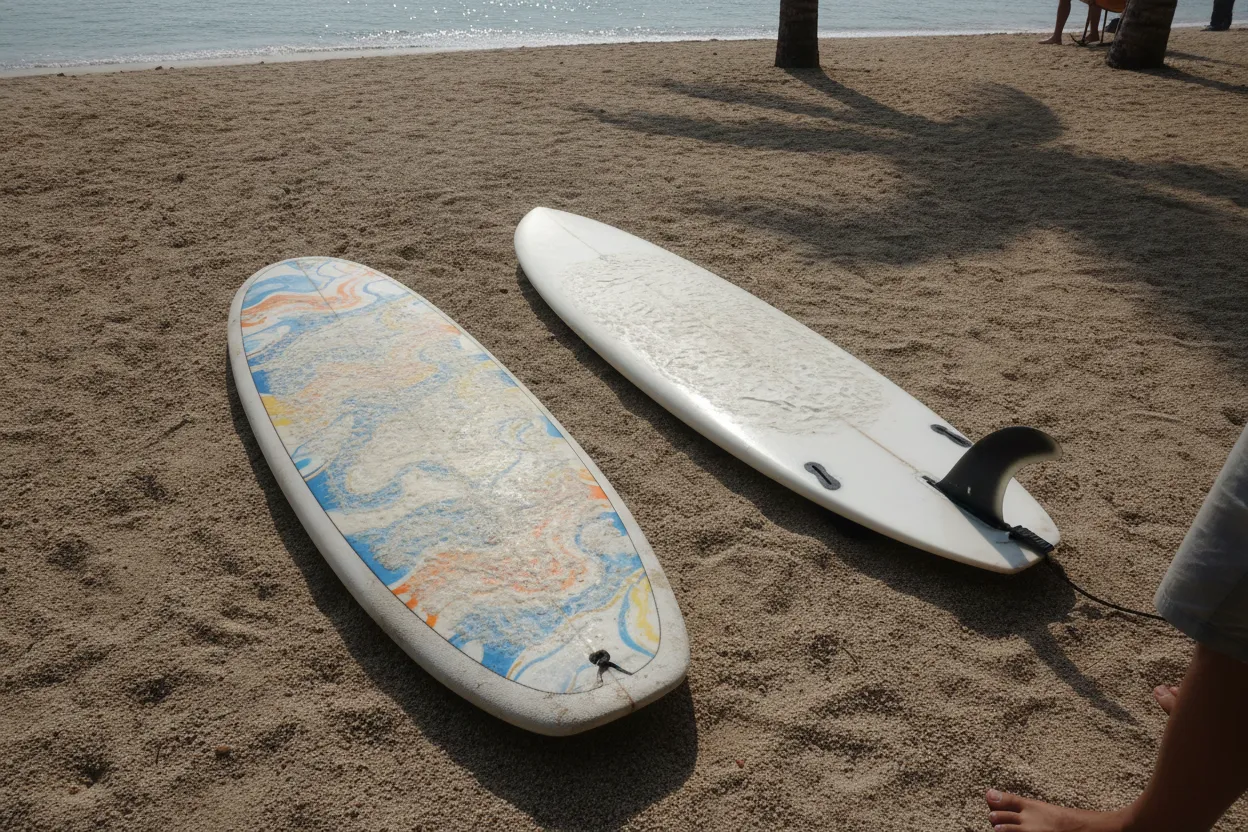
Verdict: Almost every true beginner should start on a soft-top. The only exception is a surfer who already caught whitewater waves elsewhere and is ready to progress to a harder board at a gentle beach break.
Walk onto almost any beginner-friendly beach in Bali -- Kuta, Batu Bolong, Legian, Jimbaran -- and you'll see two kinds of rental boards stacked in the racks: soft, foam-topped boards and harder fiberglass boards. New surfers often don't know which one to ask for. Here's exactly how they differ and which one is right for your first sessions.
What's the Difference?
A soft-top (foam board) has a deck made of soft EPS or EVA foam instead of hard fiberglass, usually with soft rubber or plastic fins. A hardboard (fiberglass or epoxy board) has a rigid shell over a foam core, with sharp fiberglass fins.
| Feature | Soft-Top | Hardboard (Fiberglass) |
|---|---|---|
| Safety on wipeouts | Very safe -- soft deck, soft fins | Harder edges and fins can cause cuts/bruises |
| Stability for standing up | High -- wide, thick, forgiving | Lower -- narrower, requires more balance |
| Paddle speed | Slower | Faster |
| Performance / turning | Limited | Much better once you have the skill |
| Typical rental price | Rp 50.000/hour, Rp 100.000/day | Rp 75.000-90.000/hour, Rp 150.000-180.000/day |
| Best wave type | Sandy-bottom beach breaks | Beach breaks once you're past basics, and reef breaks |
Why Soft-Tops Win for True Beginners
Soft-tops are wider and thicker relative to their length, which translates directly into more stability -- the single biggest factor in standing up on your first wave. The extra foam volume means the board floats you higher and catches whitewater waves earlier, with less paddling effort.
Safety matters just as much as learning speed. A soft-top's foam deck and flexible fins mean that if the board hits you -- which happens constantly in the first few sessions -- it's far less likely to cause a cut or bruise than a hard fiberglass edge and sharp fin setup.
When a Hardboard Makes Sense Instead
If you've already stood up and ridden whitewater on a soft-top, either in Bali or somewhere else, and you're ready to catch and ride small green (unbroken) waves, a fiberglass funboard is the natural next step. Hardboards paddle faster and hold an edge better, which matters once you're trying to angle along a wave face instead of just riding straight to shore.
Hardboards are also the only sensible choice at reef breaks like Uluwatu, Bingin, Padang Padang or Balangan -- the extra control you get from a hard rail matters more than beginner-friendliness at these waves, and in any case these breaks aren't suitable for first-timers regardless of board type.
Beach Break vs Reef Break: Why It Changes the Answer
Price Difference: Is a Hardboard Worth the Extra Cost?
Our soft-tops rent for Rp 50.000/hour or Rp 100.000/day; fiberglass funboards run Rp 75.000/hour or Rp 150.000/day, and performance shortboards Rp 90.000/hour or Rp 180.000/day. For a true first-timer, the soft-top isn't just cheaper -- it's also the board that gets you standing up fastest, so there's no reason to pay more for a harder board you're not ready to use well yet.
Common Beginner Mistakes with Board Choice
Quick Decision Checklist
FAQ
Is a soft-top board OK for intermediate surfers?
Yes, especially at gentle beach breaks -- plenty of intermediate surfers in Bali still ride soft-tops at spots like Batu Bolong or Berawa. It only becomes a limitation once you're trying to generate speed and turns on faster-moving green waves.
Can I switch from a soft-top to a hardboard rental mid-trip?
Yes -- message us when you feel ready and we'll swap your rental board type. Many renters start on a soft-top for the first few days and move to a fiberglass funboard once they're standing up reliably.
Are hardboards more dangerous for beginners?
They carry more risk of cuts and bruises from the harder rails and fiberglass fins compared to a soft-top's foam deck and soft fins, which is exactly why we recommend soft-tops for anyone who hasn't surfed before.
Do soft-tops work at reef breaks like Uluwatu?
We don't recommend them there -- the extra control of a fiberglass board matters more at a reef break than the minor cushioning benefit of foam, and reef breaks generally aren't suitable for true beginners on any board type.
What size soft-top should a beginner rent?
Most adult beginners do best on an 8-9ft soft-top. Taller or heavier surfers may want closer to 9-9'6" for extra float; ask us for a recommendation based on your height and weight when you book.
How much more does a hardboard cost to rent than a soft-top?
Roughly 50% more per hour or day -- our soft-tops are Rp 50.000/hour or Rp 100.000/day, while fiberglass funboards run Rp 75.000/hour or Rp 150.000/day.
Not Sure Which to Rent? Just Ask
Tell us your experience level and which beach you're headed to, and we'll recommend -- and deliver -- the right board. No guessing required.